
When I was 5 years old, my parents bought their first house. There was a field along the northside of the property. The property was on the outskirts of a growing community and my dad, rightly, anticipated that we might not always enjoy the privacy benefits afforded by that open field.
Our first year in the house, we planted pine trees along that 350-foot property line. Well, not trees, exactly. Seedlings, barely knee-high. That first summer, and the summer after that, I helped him haul water to every one of them.
We enjoyed watching those trees grow and thrive. We eventually sold that house, and by then the trees were as tall as me.
Today, they form a complete windbreak and privacy barrier between that property and the senior living center that eventually went up in the field next door. My dad planted trees he would never sit in the shade of. He just knew they needed to be there.
I think about that a lot in my role at Cherryland. Every investment we make, every decision our board approves, and every dollar we spend must serve our members today and protect the cooperative our kids will inherit.
Our region is growing. We all see and feel it. Our team here at Cherryland has spent a significant portion of the last few years planning and preparing for that growth.
Over the next several years, we have ambitious plans to meet this growth as we continue to move overhead lines underground, rebuild aging infrastructure, and modernize the grid with technology that makes your power more reliable and more resilient. Our members experience about one-third of the power outages of the statewide average. We intend to keep it that way.
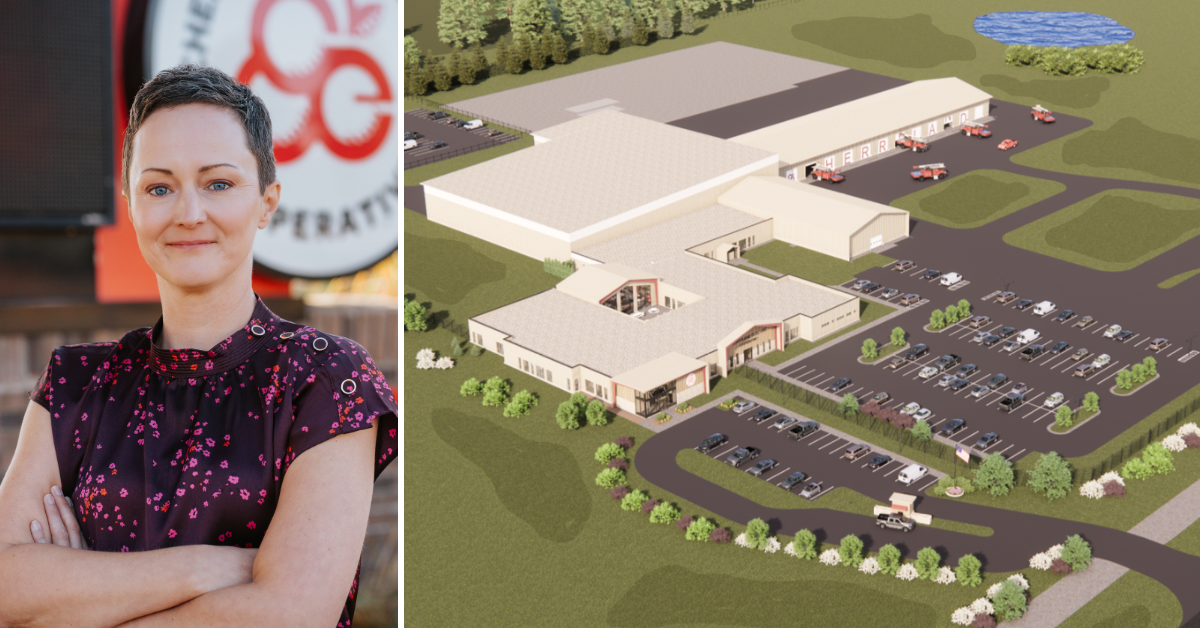
We’re also investing $35 million into our headquarters. In July, we will break ground on a new 115,000-square- foot facility that is designed to serve our growing community well into the future. Our current building was constructed in 1972, when Cherryland served less than 10,000 members across about 1,300 miles of line. Today, we serve more than 40,000 homes and businesses and maintain almost 3,400 miles of line. We looked hard at renovating our current facility. The cost was comparable to new construction, but without the longevity. Starting fresh best serves our members.
The new facility will be sized to safely store the equipment needed to maintain your service. It will include a modern, cyber-secure, storm-hardened dispatch and control center capable of operating 24 hours a day, 365 days a year.
These system and facility investments will be funded through a combination of borrowing and relying on the financial strength we’ve spent years deliberately building. Cherryland’s equity position is strong, our margins are healthy, and our borrowing costs are competitive. We built toward this moment on purpose.
I know one of your biggest questions is probably what this means for your rates. We’re finalizing a rate forecast right now, which indicates our future rate increases will remain in line with the broader inflationary environment even as we keep investing in our system on your behalf.
My dad planted those trees knowing they’d outlast him. That’s how we think about these investments—members benefit today, and the cooperative gets stronger with every year that follows. My dad understood that. So does your board of directors.
These are not decisions we make lightly. They are the result of years of planning and an unwavering commitment to keeping the lights on for our community, now and for future generations.

We see the need to upgrade and harden our infrastructure so, I support Cherryland’s plan. The hardened communication center should be a warning to us for what is coming.
Thank you for your support, Steven. I am incredibly proud of the team and their diligence in ensuring we are building to manage future risks and opportunities.
I support all that CEC is doing to provide reliable, affordable, environmentally conscientious power for us and future members. My only real objection with the new $35M facility and system upgrades is the unbalanced nature of our current billing philosophy. The cost of these investments should be distributed proportionally, according to usage. Customers who use large quantities of electricity should shoulder a proportionally large share of the cost.
CEC’s current fixed monthly fee forces members who don’t use large quantities of electricity to pay more than their fair share of these overhead costs. I understand that low fixed fees makes financial management challenging during periods of low electricity usage. That’s why you charge a little more than anticipated need and return excess through periodic capital credits.
Please re-evaluate your billing structure as you take on these large capital improvements. Find ways to reduce our monthly fixed fee, even if it means relying more on increased electricity rates and returning capital credits in the future. That’s the fair approach for our conscientious members who use less electricity.
If Roger’s assessment is correct, I concur. A flat assessment would not be fair – calculate the increased rate for improvements and infrastructure (including the new building) according to usage, please. I, too, would gladly pay a modest overage if it covers the uncertainty of estimated costs, with the comfort of knowing that Cherryland returns those to us in due time.
Thanks, Roger. I appreciate your acknowledgement of the high value service we provide to our members.
We receive a lot of questions regarding our availability charge. While sometimes unpopular, it is not unfair. The philosophy that guides our ratemaking is that all member rate classes must pay their share of our costs. We are a very capital and physical infrastructure intensive business and much of that infrastructure must be available and maintained to ensure the electricity is available to you, before you turn on the lights. These are the costs we must cover independent of how much electricity you use. When the availability is kept lower and fixed costs are built into usage rates (kWh rates), larger users are paying MORE than their fair share of our fixed costs. This tends to disproportionately impact our income-constrained members who are more likely to live in less efficient and lower quality housing. A group we certainly don’t want paying more than they should have to.
That said, we are doing a full rate study and cost of service study right now, including evaluating different rate structures for the future. We’ll be getting results of that study in the coming months and continue to evaluate if their is a better rate structure that reflects modern-day cost drivers. More to come on that in the future. Thanks for your comment.
I love this forward thinking! I take a lot of comfort in knowing that we have cooperative leaders who are willing to invest in the future. With increasing severe weather and a growing population, your actions ensure that the changes coming go as smoothly as we can make them. It is heartening to see infrastructure investment in a world where a lot of it seems to be crumbling elsewhere. Love being part of this cooperative, and love that we have actual Leaders at the helm!
Thanks, Christine. Appreciate your kind comment and support of the cooperative. We are incredibly lucky to have such a great team at the co-op, they are passionate and diligent and work very hard to make sure the cooperative is ready to serve today and into the future.
I agree that any rate increases should be
based on usage. As a vacation home owner in Thompsonville who is in residence mostly in the summer months, it wouldn’t be fair for me to pay the same rate as full time consumers. I applaud your forward thinking on an upgraded facility for the future, but fairness has to be considered.
Thanks for the note, James. We get this question frequently but it ultimately comes down to the costs we incur to make sure power is available to you whenever you want to flip the switch. Our philosophy is simply that you must pay your share of those costs, I realize that lands differently when you’re a seasonal resident but that doesn’t make it unfair. Still, this is something we regularly assess and will continue to do going forward.