
Ever tried to take a group selfie? You stretch your arm, tilt the phone, squint at the screen, and somehow still end up with everyone’s chins front and center. Finding the right angle makes all the difference.
At Cherryland, we’ve discovered that applies to power lines, too. For decades, inspecting those lines meant crews driving from pole to pole and looking at the equipment from both the ground and bucket trucks. It worked but it was slow and tedious. Then we realized maybe we just needed a better angle.
So, we took to the skies.
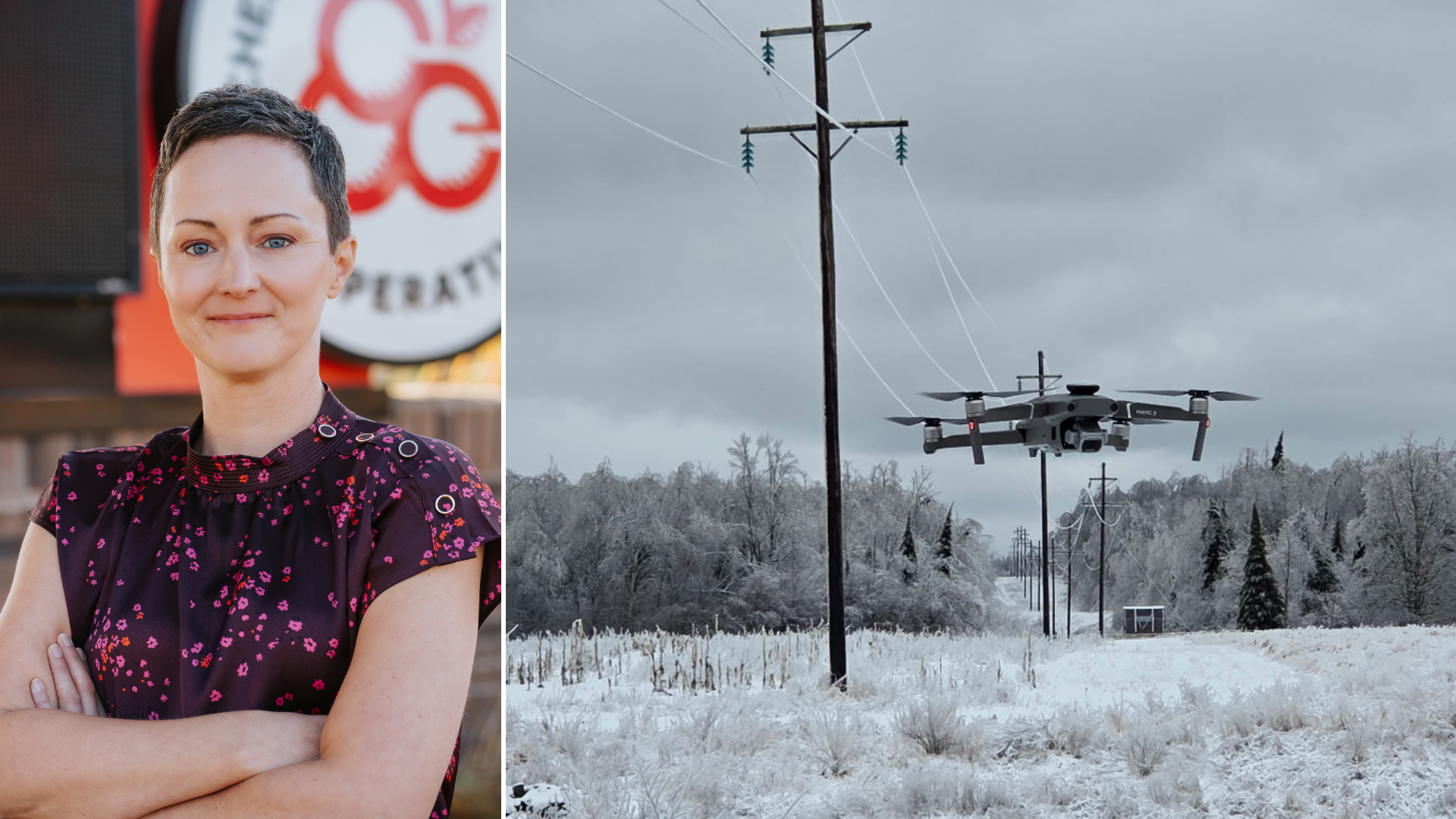
Under the leadership of Cherryland’s engineering team and with a little help from Northwestern Michigan College’s drone program, we now use high-resolution and infrared images captured by drones to analyze our system from above. These digital snapshots allow us to spot potential issues before they turn into outages.
That shift has been a game-changer for system inspection. What once took us 14 years to complete now takes just nine, and we’re on track to bring that down to seven. That means faster maintenance cycles, fewer outages, and less time spent on this necessary process. When we work more efficiently, we reduce redundant labor and travel, which helps keep costs down for our members.
When storms strike, those drones can inspect roughly 150 poles an hour, five times faster than traditional methods. It makes a huge difference when it comes to getting your lights back on faster, even in the worst conditions. It’s also making the work safer for our crews. Fewer climbs, less driving, and minimal encounters with poison ivy and mosquitoes.
But the real magic is in what comes next. Every image captured feeds into a growing library of data that helps us plan long-term maintenance and spot trends before they turn into trouble. In the future, artificial intelligence will help us sift through that data to automatically identify things like vegetation risks or equipment wear. That proactive approach lets us plan improvements thoughtfully over time, rather than reacting in the middle of an emergency. Waiting for a storm or equipment failure is almost always more costly.
Of course, with great perspective comes great responsibility. While our drones capture incredible detail, they’re focused only on Cherryland’s electric infrastructure, not what’s happening in your backyard. Every flight follows strict FAA regulations and our own data privacy policies. We take your privacy as seriously as we take reliability.
Sometimes, solving big challenges just means finding a better view. By changing our angle, literally, we’re keeping your power safer, more reliable, and more affordable.
Because whether it’s a selfie or a power pole, the right angle makes all the difference.

Will the use of this technology reduce the need for human workers? Do drones raise costs for consumers?
No to both questions. Previously we sent a line crew to each pole to inspect and then they repaired what they found. Now we send those line crews ONLY to poles that need repairs. There’s still plenty of work for them to do, we’re just not wasting their time at poles that don’t need their expertise. This has allowed us to accelerate our maintenance cycle. And, the drone program is saving our members money – it’s less expensive to perform inspections with a drone than it was with a line crew.
Rickey’s observation was what came to my mind also. That being a reduction in workforce. I’m glad to hear that no one will be RIF’ed. Also good to read of the NMC collaboration.
Great Idea
Waved down a line crew member to flag low lying branches over electric lines. He agreed and marked the trees with ribbons. That was months ago. This week I flagged down a line crew member who was cutting branches. Not my job he exclaimed, someone else should do this. I’m still waiting!
Hi Harvey – can you drop us an email with your address and/or the general location of the branches? We’ll send someone from our right of way department over to check it out. Email us at [email protected]. Thanks!
Powerline runs through trees from the transformer.
We have underground wire to the house, but from the power pole to the transformer is a hundred yards through the trees.One branch falls, it’s gonna take our power but the wire’s caught up in the trees pretty heavy.